TalkToErik
Three Week Reflection on My Time in Qingdao (Part 2 – Professional Impact)
Three Week Reflection on My Time in Qingdao Part 2 – Professional Impact This is a continuation Part 1 is here . I’m jumping in to the impact my IBM CSC assignment made to me pr...
Three Week Reflection on My Time in Qingdao (Part 2 – Professional Impact)
This is a continuation (Part 1 is here). I’m jumping in to the impact my IBM CSC assignment made to me professionally.
Let’s start with general consulting skills. Given the nature of my previous job roles, I’ve never had the opportunity to work directly with a client for this long on a consulting engagement. When I was in on the GRT / Swat Team, I definitely spent a lot of time at specific clients — Chase, Aetna, and eBay all immediately come to mind. However, in each of those activities, the main focus was establishing stability in the environment or solving specific problems, and not focusing as much on a strategic effort. I’ve also done many more short consulting based assessments, but I’ve never had the ability to stay on the project long enough to help implement the recommendations I’ve made. Long story short, seeing this full (though still brief) lifecycle of a consulting engagement was both very beneficial and interesting.
I was able to refine my consulting skills leading up to the engagement through some of the pre-training we went through, but more than anything, putting those skills into practice with a real client was invaluable. It was really interesting to have the conversations that we had with Hante and to learn from Matthias’s and Maria’s consulting styles as well. I know we all adjusted how we asked questions and drove the discussion as we learned what was working and what wasn’t with the client.
Also from a consulting perspective, I saw firsthand the importance of continuing to validate assumptions and to continuously probe to ensure that you are on the right track. Closely related was seeing first hand how having flexibility in the Statement of Work to focus on the biggest issues was important. Had we only considered the information and deliverables that we knew about after the first few days, we would have ended up much farther from the mark in the end.
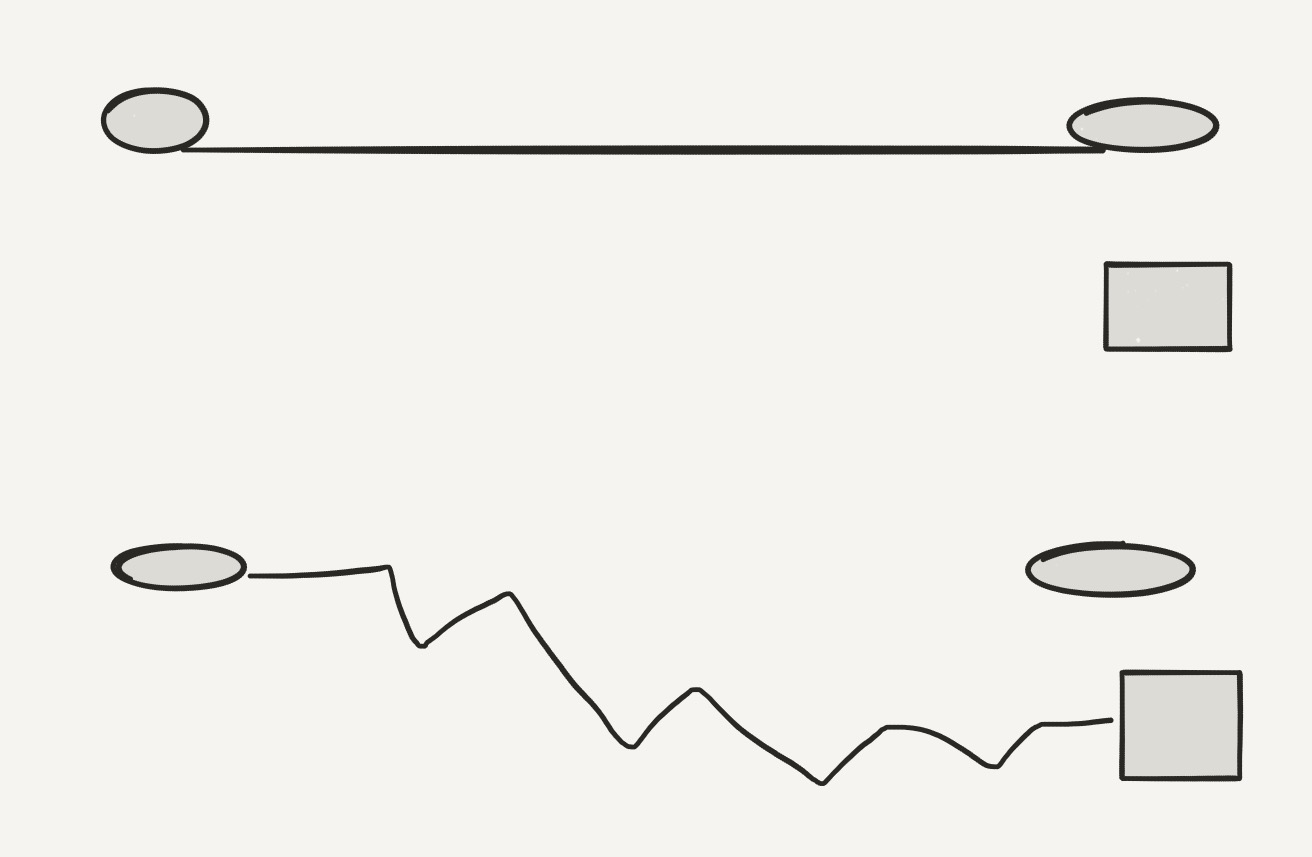
It reminds me of a picture we drew nearly a dozen times during various conversations at Hante. Essentially the top is the waterfall approach. You define the goal a the beginning and then head towards it, never changing course. The downside to this approach is that the goal likely changes (from an oval to a rectangle in this case), so you end up not achieving the right goal. The lower (agile) option is to use frequent checkpoints and adjust priorities as needed based on the new information received along the way. It could take a bit longer because it’s not a straight path, but getting the right end result is typically more important.
I also learned quite a bit just working with Matthias. He is obviously a bright guy who knows a lot about Agile and running Agile teams. I was familiar with many of the terms and concepts, but going through a deep dive with him and actually putting those ideas into practice ourselves brought much further clarity. For example, after watching him lead them several times, I know worlds more about how a morning standup meeting should be run. After using a Kanban board for four weeks, I feel like a pro!
The last major lesson learned was around negotiation and working with other strong leaders. This is something that I do on a regular basis, but the CSC assignment was a bit unique as there were no predefined roles to fall back on to give us guidance. It was really up to the three of us to sort out what we were going to do, how we were going to it, and sometimes the most difficult piece, who was going to do it. We were all selected because we were top performers, but that at times brought a bit of conflict. It took a little time to figure out our team’s rhythm and how to work best with one another. I don’t think the multicultural aspect of the team played into that too much, but there may have been some. Not to overplay on the stereotype too much, but you know those stubborn Germans. (Sorry Matthias!)
There were a few other smaller things that were reinforced from a professional side, but they made a smaller impact, primarily because these were all things that I do or have done regularly. For some of the team, working internationally was a new experience. Working with translators wasn’t new to me either, but doing so for such an extended time really made me realize how much longer things take when that’s a requirement. The same conversation takes at least twice, but more realistically three to four times as long and there’s always a little bit lost in translation — regardless of how good the girls were because there was a lot of technical info intermingled. The engagement also involved quite a bit of training and presenting to the client, but that as well is something that at this point in my career, I take as a mastered skill.
If you missed the other broader reflections, check out Part 1. Otherwise, let’s move on to some of my personal reflections in Part 3.